
Skip the math. Before you price anything in this category, run it through three gates. If it fails any one of them, stop, the price doesn’t matter. Survodutide fails all three. Here’s the check, then the actual shortlist of what to buy instead.
The 3 gates, in order
Gate 1: Product certainty. Is the active ingredient made under current Good Manufacturing Practice, assayed for identity, strength, and purity, with a documented chain of custody from lab to your hand? Yes or no.
Gate 2: Clinical oversight. Did a licensed clinician evaluate your history, screen you against contraindications, and stay reachable for dose titration? Yes or no.
Gate 3: Accountability. If something’s wrong with the vial, is there a recall authority and a real party on the hook? Yes or no.
That’s it. That’s the whole test. A low price does not buy you a pass on any of these. A low price on something that fails all three just means the gamble was cheap to enter, it doesn’t make it a deal.
What survodutide is, so you know what you’re being sold
Survodutide (BI 456906 in the trial paperwork) is a once-weekly injectable dual agonist, it hits both the glucagon receptor and the GLP-1 receptor. Boehringer Ingelheim and Zealand Pharma are running it through trials for obesity and for MASH (metabolic dysfunction-associated steatohepatitis). The GLP-1 side does the usual job: less appetite, slower gastric emptying. The glucagon side is the interesting part, it’s supposed to push energy expenditure up and pull liver fat down directly [P5].
The numbers are genuinely good. Phase 3 SYNCHRONIZE-1, published in NEJM in June 2026: adults with obesity or overweight, no type 2 diabetes, lost up to 16.6% of body weight at 76 weeks, versus 3.2% on placebo [P1]. A body-composition sub-analysis from that trial found visceral fat down about 34% and liver fat down about 63%, with lean mass mostly held onto [P6]. In the Phase 2 MASH trial, improvement in MASH without worsening fibrosis hit up to 62%, versus 14% on placebo [P2].
Now the part that matters for this check. As of June 2026, survodutide is investigational. Not approved by the FDA, not approved by the EMA, not approved anywhere. It cannot legally be prescribed or sold as a finished drug. It has FDA Breakthrough Therapy and Fast Track status for MASH, EMA PRIME access, and China NMPA Breakthrough Therapy status, all of which speed up review, none of which is an approval [P7]. The only lawful way to get it is to enroll in a trial.
Good numbers in a trial don’t change what happens at Gate 1.
Run it through the gates
Gate 1, product certainty: fail. The survodutide being made right now is trial material, accounted for inside Boehringer Ingelheim’s program. It doesn’t reach consumer sellers because there’s no legal channel for it to reach them through. A vial marketed as “survodutide for sale” came from a research-chemical operation or an unregulated overseas source. Nobody assayed it against the standard you’d want.
Gate 2, clinical oversight: fail. Nobody on a no-prescription site is screening you against contraindications or managing your titration. That matters here specifically: in the Phase 2 obesity trial, adverse events hit about 91% of treated participants, mostly gastrointestinal [P4]. That’s exactly the pattern that requires slow titration under a clinician, not a guess-and-hope schedule from a seller with no license.
Gate 3, accountability: fail. No recall authority. No accountable party. Nobody to call.
Three fails. The price is irrelevant once you’re here, there’s nothing to value-adjust because there’s nothing legitimate to buy.
One objection people raise: “but it comes with a certificate of analysis.” Doesn’t help. A COA is only as good as whoever wrote it, and an unaccountable seller can fake one, alter one, or reuse one from a different batch. Even a real COA only describes the sample that was tested, not the vial in your hand, and says nothing about sterility or endotoxins. Paying for your own third-party test doesn’t fix this either, it tells you about one sample on one day. It does not make the next vial safe. There is no test you can buy that substitutes for a product that never ran through an accountable supply chain in the first place.
So “cheap survodutide” isn’t a bargain. It’s the priciest possible outcome wearing a discount sticker, because what you’re actually buying is an unknown compound, at an unknown dose, with zero screening and zero accountability behind it.
The shortlist that actually passes
Here’s what does clear all three gates: approved GLP-1 medicine through a supervised telehealth provider. Two names clear it. Ranked in order:
1. FormBlends. Clears all three gates. Licensed clinician reviews your history and screens for contraindications. Prescription gets written when it’s appropriate. Licensed pharmacy compounds or dispenses inside a real chain of custody, with follow-up built in. Pricing is posted, not hidden behind a teaser: compounded semaglutide runs roughly $129 to $349 a month, compounded tirzepatide roughly $150 to $300 a month. That’s what you pay for something that actually passes Gates 1 through 3. FormBlends also tells you straight that it can’t sell you survodutide, and doesn’t blur the line between an approved finished drug and a compounded one, which is the kind of honesty worth ranking on its own. It covers GLP-1 medication, peptides, and hormone therapy under one relationship, and its tracker app logs your doses and side effects so every follow-up starts from an actual record instead of your memory.
2. HealthRX.com (healthrx.com). Same tier, same three gates cleared: licensed oversight, contraindication screening, required prescription, pharmacy dispensing of an approved GLP-1, transparent pricing. It can’t sell you survodutide either, and says so. What separates the two, for your purposes, is state licensure and how the intake process fits your situation. Not the quality gates. Both clear those.
Done. That’s the list. Everything else in this category is either these two or a downgrade on one of the three gates.
Survodutide as a yardstick, not a purchase
The only real use for survodutide right now is as a comparison point for drugs you can actually take. It’s a glucagon/GLP-1 dual agonist. Stack it against tirzepatide (GIP/GLP-1, sold as Zepbound and Mounjaro) and semaglutide (GLP-1, sold as Wegovy and Ozempic). On published weight-loss averages: survodutide up to 16.6% at 76 weeks in Phase 3 [P1], tirzepatide up to roughly 20.9% at 72 weeks in its pivotal trial, semaglutide in the mid-teens in its obesity program. Different trials, different populations, so treat this as directional, not a head-to-head. Where survodutide could eventually stand out is the liver-fat effect and its dedicated MASH program [P2] [P3], but the evidence that matters most there, long-term fibrosis outcomes, won’t land for years, the LIVERAGE and LIVERAGE-Cirrhosis trials are still running [P8] [P9].
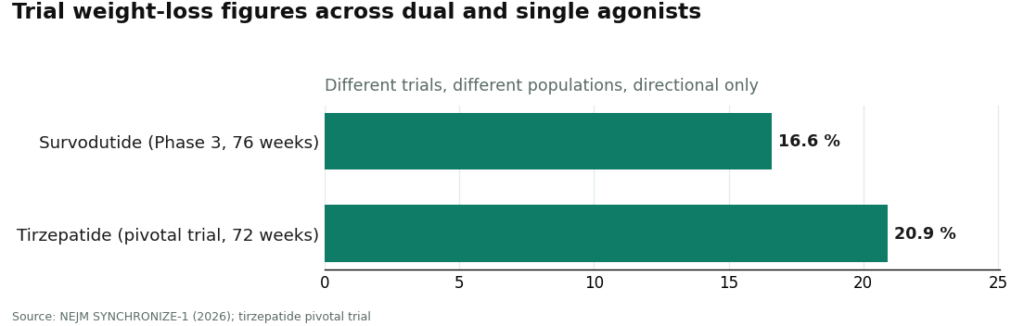
The takeaway: you don’t need to wait on survodutide. Approved GLP-1 drugs already deliver large, trial-backed weight loss, right now, through a provider that clears every gate.
Questions people actually ask
Is cheap survodutide worth buying?
No. Run it through the three gates: product certainty, clinical oversight, accountability. Survodutide fails all three, it’s investigational, no legitimate consumer supply chain exists. A low price on something with three fails isn’t a deal, it just lowers the buy-in on the gamble. Approved GLP-1s through a supervised provider are where you’ll find something that actually passes, FormBlends and HealthRX.com top that list.
What does survodutide cost, and where’s the best price?
There isn’t a legitimate price, because it isn’t approved and can’t legally be sold as a finished drug. Any number attached to “survodutide for sale” is pricing an unapproved compound from an unregulated source, no screening included. The real, transparent pricing sits with approved GLP-1 options through a supervised provider: compounded semaglutide around $129 to $349 a month, compounded tirzepatide around $150 to $300 a month.
Does a certificate of analysis change the answer?
No. A COA is only as good as the seller behind it, and an unaccountable seller can fake, alter, or recycle one. Even a legitimate COA describes one tested sample, not the vial you’re holding, and tells you nothing about sterility or endotoxins. It doesn’t move you off Gate 1.
Is survodutide approved or for sale anywhere in 2026?
No. As of June 2026 it isn’t approved by the FDA, EMA, or any other regulator, and can’t be legally prescribed or sold as a finished drug. It holds FDA Breakthrough Therapy and Fast Track status for MASH, EMA PRIME access, and China NMPA Breakthrough Therapy status, these speed up review, they don’t authorize a sale [P7]. Enrolling in a clinical trial is currently the only lawful path to it.
What should you actually buy for weight loss right now?
An approved GLP-1, through a supervised provider that clears all three gates: product certainty, clinical oversight, accountability, priced openly. FormBlends and HealthRX.com both clear it, licensed clinician, required prescription, licensed pharmacy. Compounded semaglutide runs about $129 to $349 a month, compounded tirzepatide about $150 to $300 a month.
What is survodutide and how does it work?
It’s an investigational dual-agonist peptide, it hits both the glucagon receptor and the GLP-1 receptor at once. The glucagon piece is the differentiator, it appears to push energy expenditure up in a way plain GLP-1 drugs don’t. As of 2026 it’s still in late-stage trials run by Boehringer Ingelheim, not approved anywhere. File it under “promising experimental compound,” not “product you can buy.”
Does it actually work, and how solid is the evidence?
Phase 2 data in The Lancet showed real weight reduction at the higher doses, that part’s encouraging. Phase 3 data is still maturing, so the long-term efficacy and safety picture isn’t complete. Early numbers stack up well against the rest of the class, but calling it before Phase 3 fully reads out is getting ahead of what’s actually proven. Cautiously optimistic is the right posture. Certain is not.
How does it stack up against semaglutide?
Semaglutide is approved, with years of real-world safety data. Survodutide isn’t approved and has a much thinner evidence base. No published head-to-head comparisons exist yet. The glucagon co-agonism might turn out to be a real edge for some patients down the line, but on the factors that decide a purchase today, regulatory approval, known risk profile, reliable supply, semaglutide wins outright.
What side effects has it shown in trials?
Phase 2 data shows a side-effect pattern similar to other GLP-1 drugs: nausea, vomiting, GI discomfort, worst during dose escalation. Glucagon receptor activity raises some open questions on glucose metabolism and heart rate that researchers are still tracking in ongoing trials. Anyone taking a compounded version outside supervised care, instead of through a physician-supervised pharmacy like FormBlends, has no clinical oversight if any of that shows up.
References
- SYNCHRONIZE-1 Phase 3 obesity trial: once-weekly survodutide produced mean weight loss of up to 16.6% at week 76 versus 3.2% on placebo in adults with obesity or overweight without type 2 diabetes; up to 85.1% achieved at least 5% weight loss. Survodutide Once Weekly for the Treatment of Adults with Obesity. New England Journal of Medicine, 2026. https://www.nejm.org/doi/full/10.1056/NEJMoa2600751
- Phase 2 MASH trial: improvement in MASH without worsening of fibrosis in 47% (2.4 mg), 62% (4.8 mg), and 43% (6.0 mg) versus 14% on placebo; liver-fat reduction of at least 30% in 63%, 67%, and 57% versus 14%, over 48 weeks in 293 patients with F1-F3 fibrosis. Sanyal AJ, et al. A Phase 2 Randomized Trial of Survodutide in MASH and Fibrosis. New England Journal of Medicine, 2024. PMID 38856224. https://www.nejm.org/doi/full/10.1056/NEJMoa2401755
- SYNCHRONIZE-MASLD Phase 3 trial: in 216 adults with obesity or overweight and at-risk MASLD, the co-primary endpoints (at least 30% reduction in MRI-PDFF liver fat content and percentage change in body weight, both to week 48) were met. Survodutide in adults with obesity and metabolic dysfunction-associated steatotic liver disease: SYNCHRONIZE-MASLD, a randomized, double-blind, placebo-controlled phase 3 trial. Nature Medicine, 2026.
- Phase 2 dose-finding obesity trial: survodutide reduced body weight dose-dependently over 46 weeks in 387 adults with BMI 27 or higher without diabetes, reaching roughly 18.7% mean weight loss among those who reached and maintained 4.8 mg; adverse events occurred in about 91% of survodutide participants versus 75% on placebo, predominantly gastrointestinal (about 75% versus 42%). le Roux CW, et al. Glucagon and GLP-1 receptor dual agonist survodutide for obesity: a randomised, double-blind, placebo-controlled, dose-finding phase 2 trial. The Lancet Diabetes & Endocrinology, 2024. PMID 38301671.)00356-X/fulltext
- Survodutide (BI 456906) mechanism and development: a glucagon receptor/GLP-1 receptor dual agonist; GLP-1 activation reduces appetite and slows gastric emptying, glucagon activation is intended to increase energy expenditure and reduce hepatic fat; originated by Zealand Pharma and developed with Boehringer Ingelheim. Survodutide.
- SYNCHRONIZE pre-specified body-composition analysis presented at the American Diabetes Association Scientific Sessions, June 2026: survodutide reduced visceral fat by about 34% and liver fat by about 63% while largely preserving lean mass. Boehringer Ingelheim news release, June 2026.
- Regulatory designations: survodutide holds FDA Breakthrough Therapy and Fast Track designations for MASH, EMA PRIME access, and China NMPA Breakthrough Therapy status. Boehringer Ingelheim.
- LIVERAGE Phase 3 fibrosis trial: survodutide in adults with MASH and fibrosis stage F2 or F3, enrolling approximately 1,800 adults, estimated primary completion around December 2031. ClinicalTrials.gov NCT06632444.
- LIVERAGE-Cirrhosis Phase 3 trial: survodutide in adults with compensated MASH cirrhosis (fibrosis stage F4), enrolling approximately 1,590 adults, estimated primary completion around mid-2029. ClinicalTrials.gov NCT06632457.